
- Home
- Departments
- Community Development
- Building Inspections
- Pool Requirements
Pool Requirements
Barrier and Safety Requirements Residential Pools, Spas, and Hot Tubs
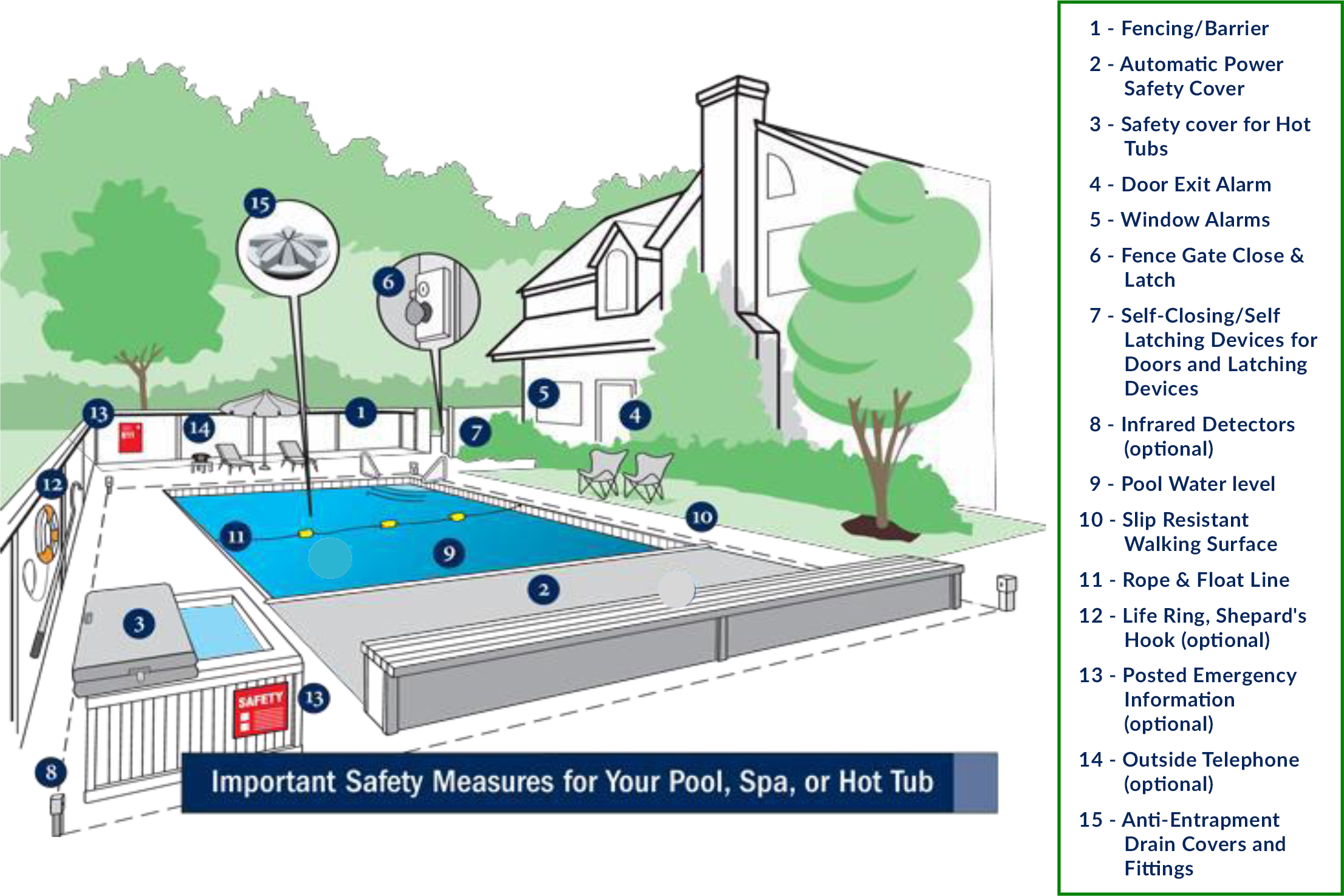 GENERAL
The provisions of this document shall control the design, construction, and installation of barriers, safety devices and equipment for swimming pools, spas and hot tubs installed in or on the lot of a one- or two-family dwelling.
DEFINITIONS
For the purpose of these requirements, the terms used shall be defined as follows and as set forth in the Virginia Residential Code, and the International Swimming Pool and Spa Code. Please refer to the Virginia Uniform Statewide Building Code, (VUSBC) webpage and the International Swimming Pool and Spa Code, (ISPSC) for more information on the codes and code year which are applicable to your project.
PERMITS
Any owner, or owner’s authorized agent who desires to construct, enlarge, alter, repair, move, or demolish a pool or spa or to erect, install, enlarge, alter repair, remove, concert or replace any system, the installation of which is regulated by this code, or to cause any such work to be performed will require a building permit.
All pools that incorporate lighting, circulation equipment, or receptacle outlets will require an electrical permit.
All pools with “field installed” heaters will require a mechanical permit. All “fuel fired” pool heaters will require a Gas Permit.
All pools with a permanent fill line or connection to sanitary sewer will requires a Plumbing Permit.
BARRIER REQUIREMENTS
All pools, spas, and hot tubs must be provided with a code compliant barrier per the ISPSC.
Alarms: Alarms must be listed and labeled as a water hazard entrance alarm in accordance with UL 2017.
HEIGHT AND CLEARANCES
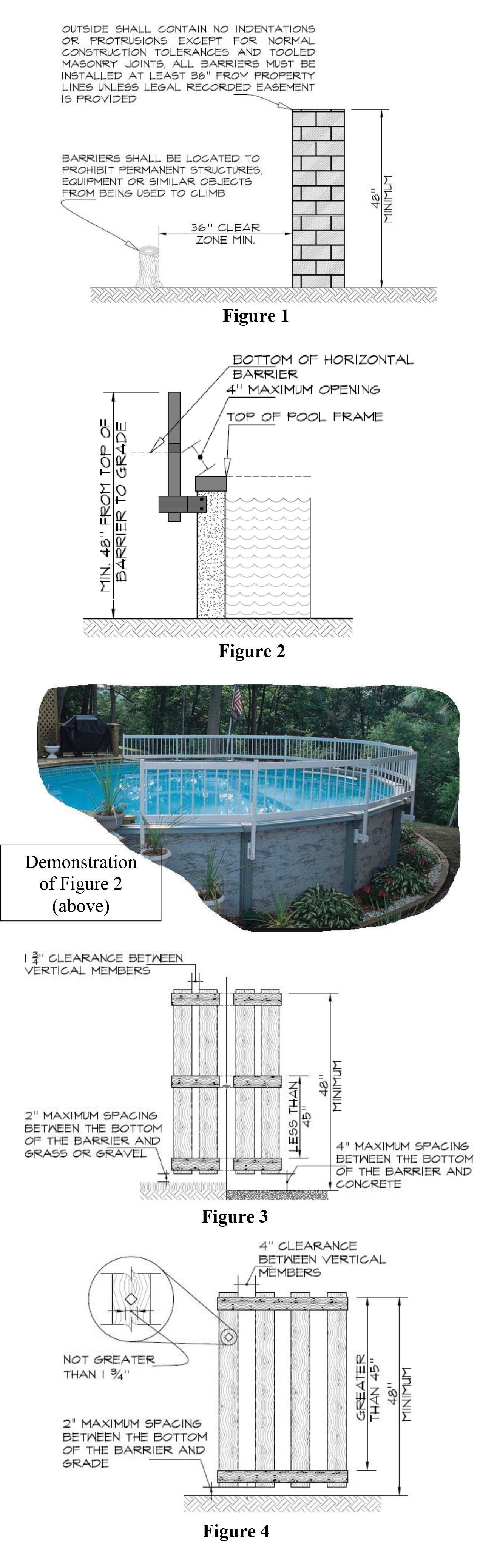
- The top of the barrier shall be at least 48” above grade, measured on the side of the barrier which faces away from the swimming pool. The maximum vertical clearance between grade and the bottom of the barrier shall be 2 inches for grade surfaces such as grass, mulch, and gravel, and 4” for solid surfaces such as concrete, See Figure 3. Where the barrier is mounted on top of the pool structure, the maximum vertical clearance between the top of the pool structure and the bottom of the barrier shall be 4 inches. See Figure 2.
- Openings in the barrier shall not allow passage of a 4 inch-diameter sphere.
- Solid barriers which do not have openings, such as a masonry or stone wall, shall not contain indentations or protrusions except for normal construction tolerances and tooled masonry joints. See Figure 1.
HORIZONTAL AND VERTICAL MEMBERS
- Where the barrier is composed of horizontal and vertical members and the distance between the tops of the horizontal members is less than 45 inches, the horizontal members shall be located on the swimming pool side of the fence. Spacing between vertical members shall not exceed 1¾ inches in width. Where there are decorative cutouts within vertical members, spacing within the cutouts shall not exceed 1¾ inches in width.
See Figure 3. - Where the barrier is composed of horizontal and vertical members and the distance between the tops of the horizontal members is 45 inches or more, spacing between vertical members shall not exceed 4 inches. Where there are decorative cutouts within vertical members, spacing within the cutouts shall not exceed 1¾ inches in width. See Figure 4.
 CHAIN LINK
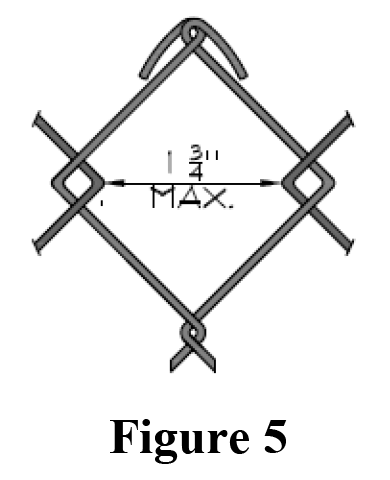
Maximum mesh size for chain link fences shall be a 1¾ inch measured along the horizontal axis. See Figure 5.
 LATTICE
Where the barrier is composed of diagonal members, such as a lattice fence, the maximum opening formed by the diagonal members shall not be more than 1¾ inches. See Figure 6.
 MESH RESTRAINING BARRIER
Mesh fences listed and installed per the manufacturers installation instructions, and in accordance with their listing and the ISPSC.
ACCESS GATES AND LATCHES
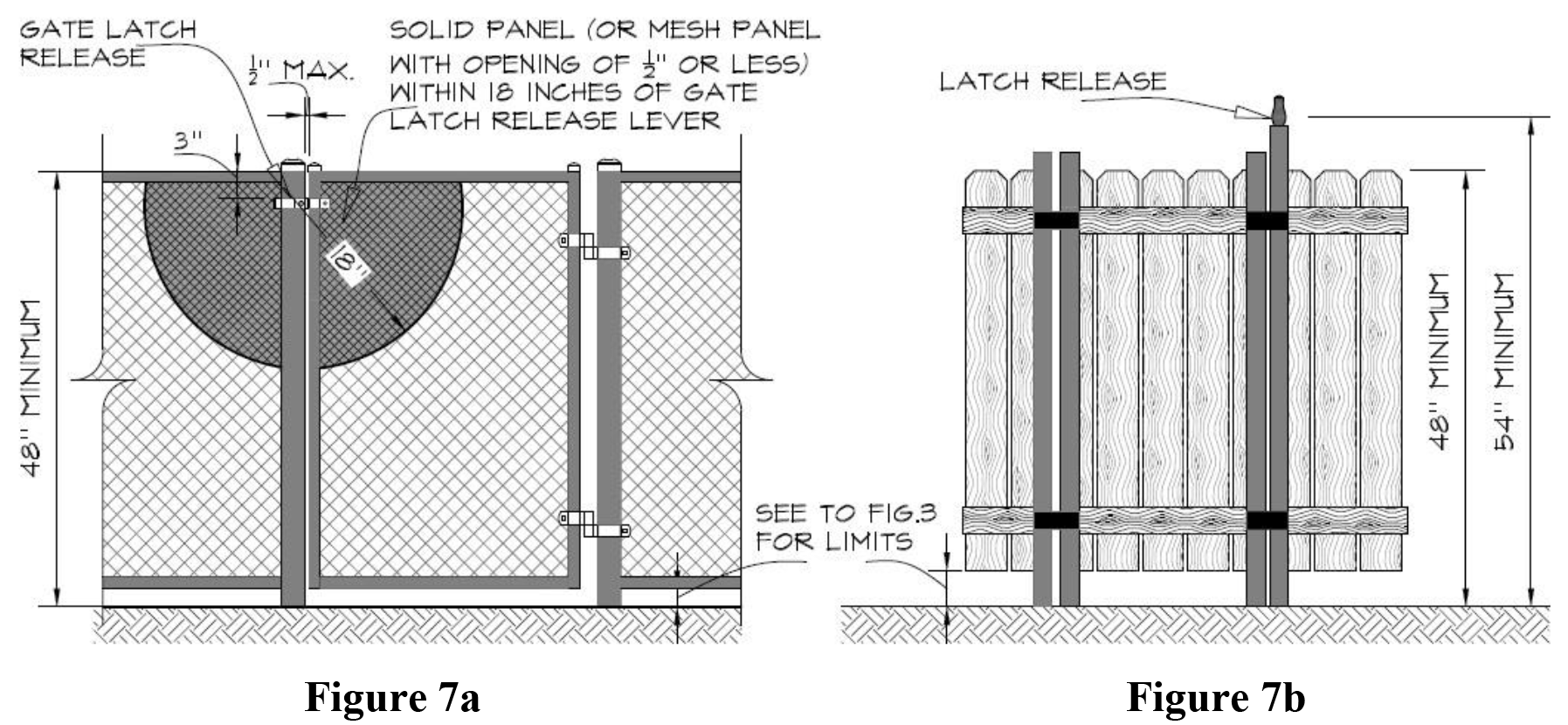
Access gates shall comply with barrier requirements and shall be equipped to accommodate a locking device. Pedestrian access gates shall open outward away from the pool and shall be self-closing and have a self- latching device. Utility and service gates shall be locked when not in use. Where the release mechanism of the self-latching device is located less than 54 inches from grade, the release mechanism and openings shall comply with the following:
- The release mechanism shall be located on the pool side of the gate at least 3 inches below the top of the gate; and
- The gate and barrier shall have no opening larger than ½ inch within 18 inches of the release mechanism. See Figures 7a &b.
WALL OF DWELLING AS BARRIER
Where a wall of a dwelling serves as part of the barrier, one of the following conditions shall be met:
- The pool shall be equipped with a powered safety cover in compliance with ASTM F1346; or
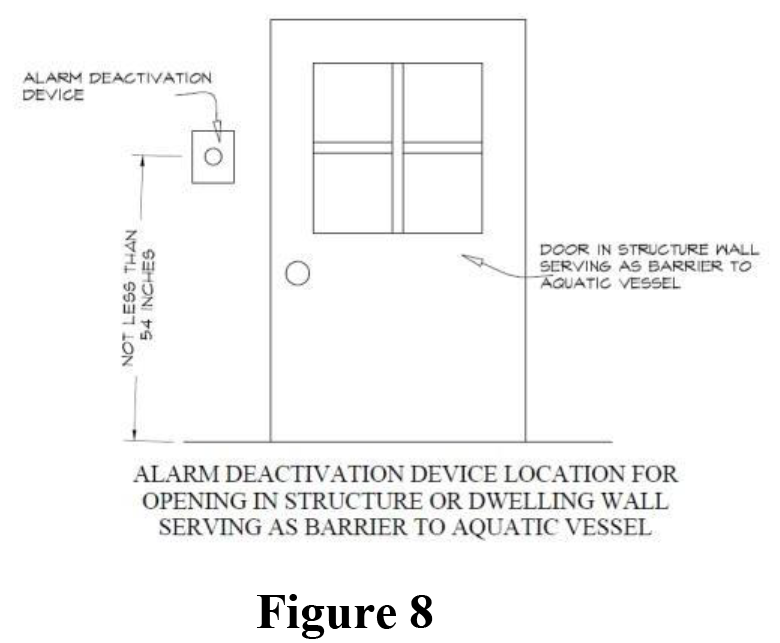
- Doors, and operable windows with sill height of less than 48”, with direct access to the pool, shall be equipped with an alarm in accordance with UL 2017. The deactivation switch(es) shall be located at least 54 inches above the threshold of the door. See Figure 8
- An approved means such as a self-closing, self-latching device provided the level of protection is equal to or greater than items 1. and 2. above.
 POOL STRUCTURE AS BARRIER
Where an above-ground pool structure is used as a barrier or where the barrier is mounted on top of the pool structure and the means of access is a ladder or steps:
- The ladder or steps shall be capable of being secured, locked, or removed to prevent access; or:
- The ladder or steps shall be surrounded by a code compliant barrier. When the ladder or step are secured, locked, or removed, any opening created shall not allow the passage of a 4-inch diameter ball.
PROHIBITED LOCATIONS
- CLEAR ZONE There shall be a clear zone of not less than 36 inches (914 mm) around the exterior of the barrier and around any permanent structures or equipment such as pumps, filters and heaters that can be used to climb the barrier. Barriers must be installed at least 36 inches from property line unless legal recorded easement is provided. SEE FIGURE 1
- POOLSIDE SETBACK. The pool side of the required barrier shall be not less than 20 inches from the water’s edge.
REQUIRED SAFETY GLAZING
Glazing (glass) in walls and fences enclosing indoor and outdoor swimming pools, hot tubs, and spas where the bottom edge of the glazing is less than 60 inches (1524 mm) above a standing or walking surface and within 60 inches (1524 mm) horizontally of the water’s edge. This shall apply to single and all panes in multiple glazing.
SAFETY AND WALKING SURFACES
- All decks/walking surfaces surrounding pools must be slip resistant and constructed in accordance with the ISPSC.
- LADDERS, STAIRS, DECKS AND HANDHOLDS for above ground pools must be installed per the manufacturer’s installation instructions, and the ISPSC.
- All pools exceeding 42” in depth must be provided with “handholds” per the ISPSC
- All DRAIN COVERS must be listed, labeled and dated per APSP 7 for suction entrapment avoidance
- Exception: Portable spas, exercise spas and hot tubs listed and labeled in accordance with UL 1563
- All CIRCULATION PIPING and fittings must be installed to provide suction entrapment avoidance.
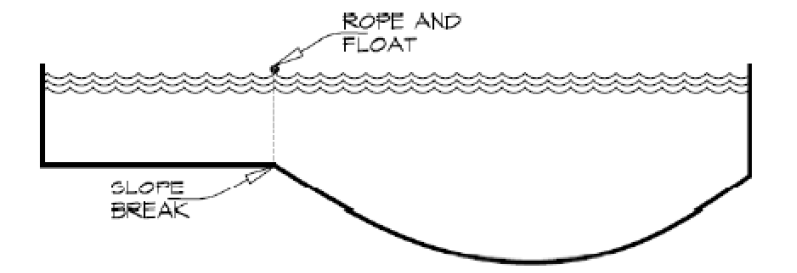
- A ROPE AND FLOAT must be installed at the 1st slope break.
 DRAINING OF POOL/SPA WATER
Per City of Salem Water Department, dechlorinated water from pools and spas can go into storm drain. If not dechlorinated, water must go into sewer.